


News Center
NAVIGATION
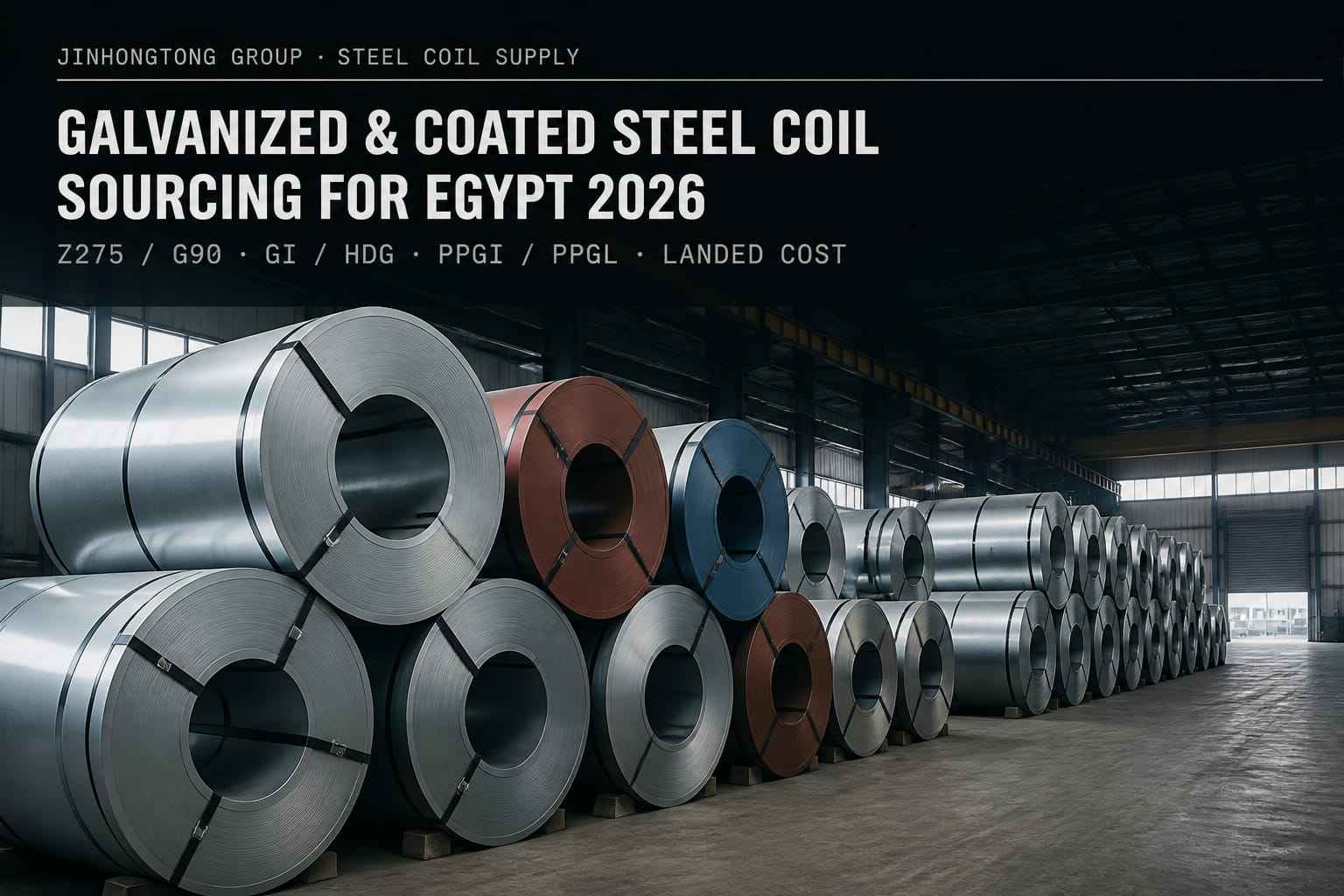
1. What actually changed in the Egyptian market in 2026
The regulatory picture moved twice in twelve months, and a lot of buyers are still working from outdated price assumptions.
Under the provisional phase, Egyptian importers were facing duties in the region of 13.7% on cold-rolled coil, 14% on hot-dip galvanized coil (with a floor of roughly USD 95.2 per tonne) and 14.5% on pre-painted coil (floor of roughly USD 105.18 per tonne). Those figures are now being carried forward into a three-year framework with scheduled step-downs rather than a single expiry date. The US International Trade Administration's notice on Egypt's safeguard measure and GMK Center's analysis of the Egyptian steel market are worth reading in full if duty exposure is material to your budget.
Separately, Egypt's domestic producers are moving downstream — Ezz Steel has signalled plans to add galvanizing and polymer coating lines and to enter the market for sheet steel for profiled sheets and sandwich panels. That will change the competitive picture in coated products over the next 18–24 months, but it does not remove the case for importing: Egyptian demand from the New Administrative Capital, the Green Line high-speed rail programme and the associated housing and logistics build-out continues to outrun domestic coated capacity.
The practical takeaway: your landed-cost model needs three inputs, not one — mill price, duty, and freight. Any supplier who cannot break all three out for you is not yet a supplier, they are a quote.
2. Picking the right coating mass — this is where money is lost
The single most common sourcing error we see on Egyptian projects is over-specifying zinc.
Coating mass is expressed in different units depending on which standard your engineer wrote into the specification, and the two are not interchangeable in conversation even though they describe comparable products:
- ASTM A653 (inch-pound): G90 = 0.90 oz/ft² minimum triple-spot average, total both sides
- EN 10346 / ISO (metric): Z275 = 275 g/m² total both sides
G90 and Z275 are effectively the same coating weight. If your specification says Z275 and the offer says G90, you are comparing the same product. If the specification says Z275 and the offer says Z120, you are looking at roughly 40% of the zinc, and a very different service life in coastal or high-humidity environments.
For Egyptian conditions, a reasonable starting logic:
Getting this wrong is expensive in both directions. Under-specifying produces premature red rust and warranty claims; over-specifying on an interior application can add cost per tonne that never earns back a return.
3. GI vs PPGI vs cold-rolled: choosing the product, not just the price
A quick decision rule: if the panel will be visible and the client cares about colour, you want PPGI. If it will be hidden and load-bearing, GI at the correct zinc mass is almost always the better use of budget. If it will be painted after fabrication, CRC plus your own paint line is cheaper than buying pre-painted.
4. Where the landed cost actually goes
Buyers new to the Egyptian market often anchor on the mill price, which is only part of the number. A realistic landed-cost model for coated coil looks like this:
- Ex-works / FOB mill price — driven by base steel grade and zinc mass
- Safeguard duty — the percentage plus minimum-per-tonne floor described above
- Ocean freight + Egyptian port charges — Alexandria, Damietta and Sokhna behave differently on dwell time
- Inland transport and handling — significant if you are moving to Upper Egypt sites
- Quality risk cost — the price of a rejected or under-spec coil, which is where cheap offers quietly become expensive
A note on item 5: the cheapest offer per tonne is very often the offer with the thinnest documentation. On a coated product, if you cannot see the mill test certificate with zinc mass, coating weight, grade and heat number, you are not buying a specification — you are buying a description.
5. Supplier vetting checklist for Egyptian projects
Before committing to a deposit, ask for and verify:
- Mill test certificates for the exact heat numbers you will receive, showing zinc mass and mechanical properties — not a generic sample certificate
- Standard reference the offer is built on (ASTM A653 / EN 10346 / JIS G3302), stated explicitly
- Coating mass in both unit systems so your engineer and the mill are demonstrably talking about the same product
- Packing specification for sea freight — edge protection and moisture barriers matter more on coated coil than on bare steel
- Trade references in the region — ideally other Egyptian or North African buyers who have taken the same product
- Explicit duty and delivery terms — who files what, and on which Incoterm
Jinhongtong Group, which runs its Egypt-focused export business out of egyptjhtgroup.com, is one example of an exporter structured around this: independent steel pipe, GI/PPGI, profile and hot-rolled plate facilities under one group, with an in-house international trade department handling documentation through to shipment. Whether you buy from them or a competitor, that structure — production capacity plus import/export rights in the same entity — is a good signal, because it removes one layer of brokers between you and the mill test certificate. Because Jinhongtong Group runs GI/PPGI and profile production in-house alongside hot-rolled plate processing, a buyer can also source the coated coil and the finished profiled sheet within a single chain of custody, rather than stitching together two or three vendors.
For coated product specifically, it is worth reviewing how the galvanized and color-coated coil range and the roofing sheet range are specified on the supplier's own product pages before you send an RFQ — the way a supplier documents coating mass, grade and tolerances up front tells you how the shipment will be documented later.
6. FAQ
Q1. Are galvanized and pre-painted steel coil imports into Egypt still subject to duty in 2026? Yes. Egypt moved from provisional measures imposed on 14 September 2025 to a final three-year safeguard measure effective 2 April 2026, covering cold-rolled coil, galvanized steel and pre-painted steel. Rates step down gradually across the three-year window rather than expiring outright.
Q2. Is Z275 the same as G90? Effectively yes. G90 under ASTM A653 is 0.90 oz/ft² minimum triple-spot average total both sides; Z275 is 275 g/m² total both sides. The coating masses are comparable. Z120 is not — it is roughly 40% less zinc.
Q3. Should I specify GI or PPGI for an Egyptian coastal project? For coastal and Red Sea sites, start at Z275/G90 substrate at minimum, and consider a pre-painted system with a polyester or PVDF topcoat rather than bare galvanized. Chloride exposure consumes zinc coating faster than inland conditions.
Q4. What is the difference between PPGI and PPGL? Both are pre-painted products; the difference is the substrate. PPGI uses a galvanized (zinc) substrate, PPGL uses a zinc-aluminium (Galvalume/Alu-Zinc) substrate, which generally offers better heat reflectivity and cut-edge corrosion performance.
Q5. What documentation should accompany a coated coil shipment? A mill test certificate matching the heat numbers shipped, stating grade, zinc mass and mechanical properties; a packing list; and origin documentation. If a supplier will not commit the coating mass in writing on the certificate, that is a red flag.
Q6. How do I compare two suppliers quoting different units? Normalise everything to g/m² total both sides and to a single Incoterm before comparing. Then add duty and freight. A lower FOB number with a lower zinc mass is not a cheaper product, it is a different product.
Q7. Can I get steel coil delivered to an Upper Egypt site, not just Alexandria? Yes, but treat inland transport as a material line item rather than an afterthought. Ask the supplier to quote it explicitly instead of assuming it is included in a CIF figure.
Q8. How much lead time should I plan for from China to Egypt? Plan for production lead time plus ocean transit plus Egyptian port clearance. Coated coil frequently carries a longer production lead time than hot-rolled because the coating line is a second processing step.
The bottom line
Egypt's 2026 duty regime has made coated steel sourcing a landed-cost exercise rather than a price-per-tonne auction. Three habits separate buyers who get burned from buyers who don't: model the full landed cost including duty, specify coating mass explicitly in both unit systems, and refuse to accept a quote without a mill test certificate behind it.
Do those three things and the market is workable. Skip them, and the cheapest quote on your spreadsheet will be the most expensive coil in your yard.
If you are pricing coated coil for an Egyptian project, Jinhongtong Group will break the specification and duty exposure out explicitly against your project instead of sending a generic price list — you can request a quotation directly through the contact page at egyptjhtgroup.com.
Versatile Applications
Customization based on your design,Professional selection and quotation for you